This week brought a high-end guitar amp emulation, a dual-mode glitch tool, a free tilt EQ with an unusual saturation mechanic, and a solo strings library built entirely around unsettling people. No filler.
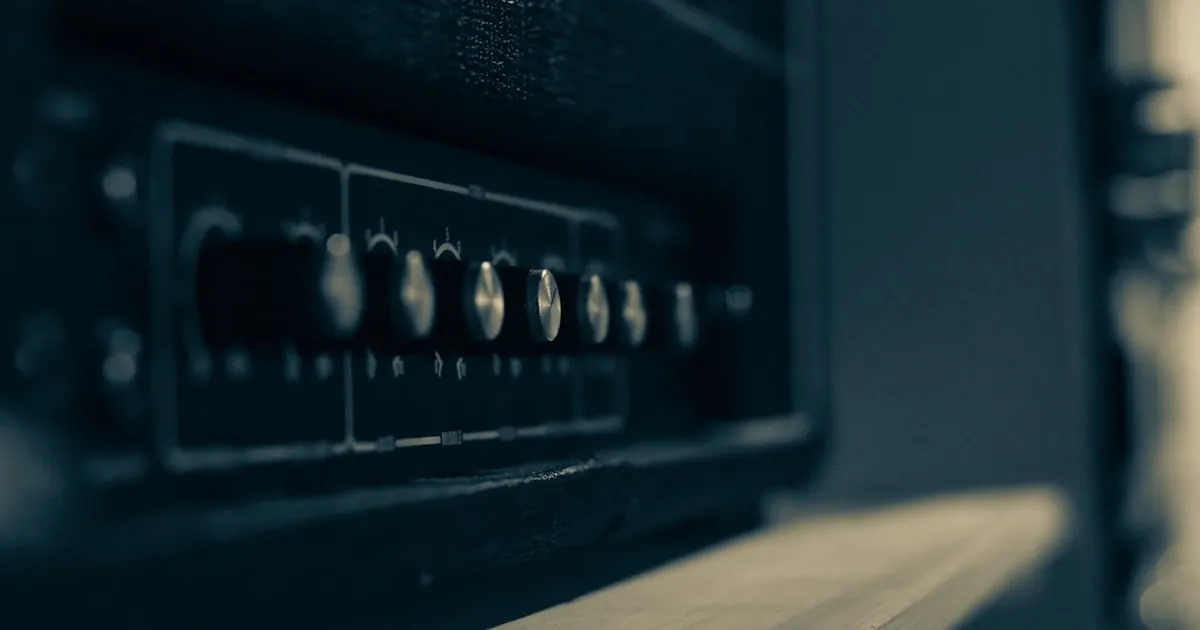
UAD Enigmatic '82 Overdrive Special Amp by Universal Audio ($49 intro / $99 regular)
The D-style amp is one of the most storied and inaccessible circuits in guitar history. Alexander "Doc" Dumble hand-built fewer than 300 amplifiers during his lifetime, with used units selling between $30,000 and $100,000 on the rare occasions they appear. The sonic signature, extended clean headroom that collapses into extremely musical harmonic saturation when pushed, has been the reference point for players like Eric Clapton, Carlos Santana, and Stevie Ray Vaughan since the late 1970s.
UAD's Enigmatic '82 models four circuit generations of the D-style design across three voicings: Rock, Jazz, and Custom. According to Universal Audio's product description, each voicing targets a different gain staging emphasis within the Dumble-derived topology. Nine microphone and cabinet combinations are included, covering close single-mic positions through room configurations, and the plugin includes the Hot Rubber Monkey (HRM) modification option, an additional gain stage that Dumble developed as a factory add-on for his amplifiers.
The practical case for this over generic amp sims is in how the circuit responds to dynamics. D-style amps have unusually wide clean headroom relative to their saturation ceiling, which means playing velocity and guitar output level produce qualitatively different tonal results rather than just louder or quieter versions of the same sound. That dynamic behavior is difficult to fake with static EQ curves, and it's the main thing Dumble hardware commands the price it does.
No Apollo hardware required. VST3, AU, AAX on macOS and Windows. Intro price of $49 holds until May 25.
Good for: Electric guitar recording, and any context where you want boutique amp character for synth leads or processed material. Less relevant if you're not tracking or treating pitched sources.
W.A. Production Particle Pie ($12 intro / $39.90 regular)
Particle Pie runs two fundamentally different audio destruction approaches in parallel and gives you a morphing XY pad to blend between them. The first engine is a spectral glitcher: it operates in the frequency domain, breaking the incoming signal into FFT bins and rearranging them in ways that produce stuttering, smearing, and spectral fragmentation. The second is a granular particle engine: it works in the time domain, slicing audio into short grains and controlling their playback timing, pitch, and density.
These produce genuinely different textures. Spectral glitching tends to preserve harmonic relationships while dislocating them in time. Granular processing smears transients and introduces pitch spread. The five character types (described as smooth to gritty) adjust how aggressively each engine fragments the signal. Independent Stretch and Length controls operate per engine, which means you can set the spectral side to stutter on rhythmic boundaries while the granular side flows continuously underneath.
The XY pad's value is in finding the transition zone between both engines where neither is fully dominant. That intermediate state produces textures neither engine generates alone, and it's the most interesting part of the plugin.
Available in VST2, VST3, AU, AAX on macOS and Windows. $12 intro price holds until May 21 (70% off the regular $39.90).
Good for: Sound design, electronic music production, transforming static loops into evolving textural material. This is a creative destruction tool, not a utility effect. If you need transparent results, look elsewhere.
Techivation Tilt EQ (Free)
Tilt EQs have a simple premise: rotate the frequency balance around a center pivot point, brightening highs while darkening lows or vice versa. Most implementations apply a complementary shelving filter pair and stop there. Techivation adds one mechanism that changes the practical result considerably: the Drive control.
When you darken a signal by tilting the EQ, you're attenuating high-frequency content. Normally this reduces apparent density at higher tilt amounts. The Drive control intercepts the energy being removed and routes it into a saturation stage, converting the cut frequencies into harmonic content rather than eliminating them. Darkening the signal adds warmth instead of thinning it out, which is a different kind of tonal shaping than a conventional shelving pair achieves.
The underlying EQ operates in linear phase, meaning a symmetric FIR design with compensated latency rather than IIR shelving filters. The up-to-8x oversampling applies to the Drive saturation stage specifically, controlling aliasing from the nonlinear processing without adding linear-phase latency to the EQ section itself. M/S processing and stereo balance are included. The spectrum analyzer supports A/B comparison.
Free download requires a Techivation account. VST, VST3, AU, AAX on macOS (Intel and Apple Silicon) and Windows.
Good for: Mix bus and mastering contexts where you want tonal balance adjustment without sacrificing density. The Drive mechanism makes this more useful than a simple tilt shelver for final-stage processing where you'd normally reach for both a tilt EQ and a separate tape saturation plugin.
Infernus Strings by Elastic Sounds ($99 intro / $179.99 regular) (Indie Pick)
The most specialized release of the week. Infernus Strings is a solo horror strings library for Kontakt 6.8 or later, featuring solo double bass, cello, viola, and violin recorded with extended techniques geared specifically toward tension and unease: sul ponticello (bowing near the bridge for an abrasive, glassy tone), col legno (striking or bowing with the wooden back of the bow for a clacking, percussive texture), natural and artificial harmonics, flutter pressure, and sustained dissonant clusters.
The central feature is the additive matrix engine, which lets you layer multiple articulations from different instruments simultaneously and control their relative density independently. Stacking a cello sul ponticello layer against a violin harmonics layer with independent amplitude envelopes produces material that a single-instrument approach doesn't. The 30+ factory presets are organized by tension category (dread, impact, textural), which is useful as entry points but the matrix is where the actual sound design happens.
Using solo instruments rather than sections gives you direct control over density and spatialization. String sections record multiple players together, which blends their micro-timing and pitch variations into a unified mass. Solo recordings preserve individual instrument character, which matters for horror textures where the irregularity and fragility of a single player is part of the effect.
Available via KVR Audio. Requires the full version of Kontakt (not compatible with the free Kontakt Player). $99 intro.
Good for: Cinematic scoring, game audio, any context where conventional string articulations are too clean or too comfortable. If you're scoring something that needs to unsettle people on a technical level, this is a more purpose-built tool than repurposing a standard orchestral library's "extended techniques" presets.