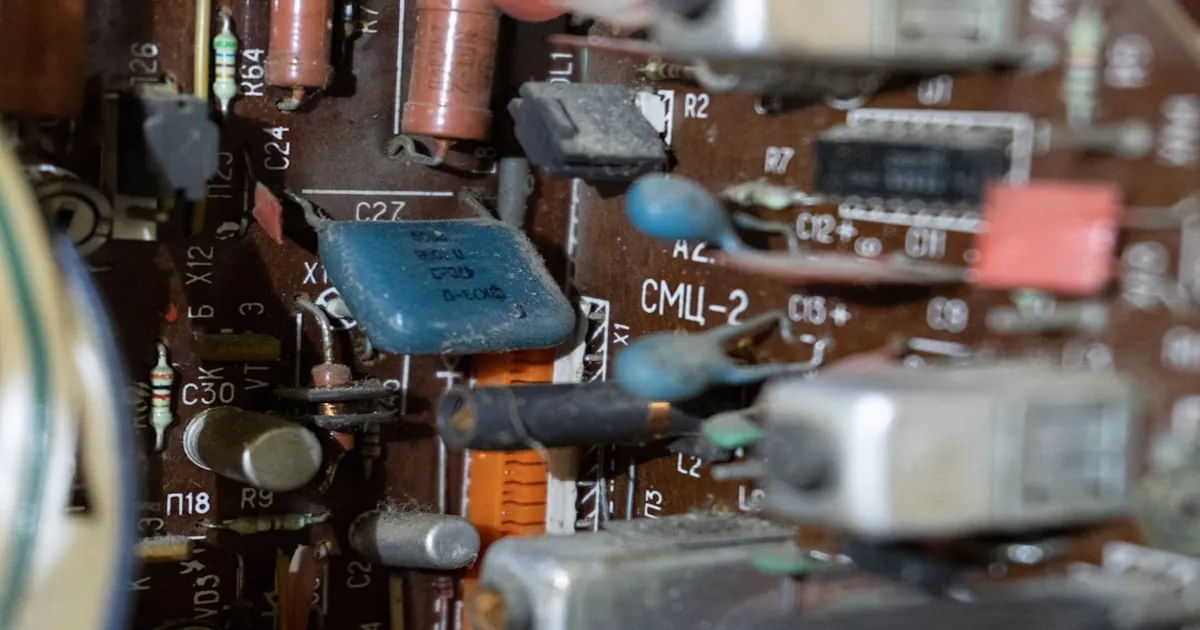
The lush shimmer of analog chorus and the jet-plane sweep of flanger both trace to a single circuit concept published in 1969 by F. Sangster and K. Teer at Philips Research Labs in the Netherlands. Their bucket brigade device, named after the old firefighting technique of passing buckets down a line, turned out to define the sound of electric guitar, synthesizer, and studio processing for the next four decades. What most people do not know is that the "warmth" widely attributed to these circuits comes almost entirely from filters that exist only because the BBD itself creates a noise problem.
How a Bucket Brigade Actually Works
A BBD chip is a series of capacitor stages connected in sequence. Each stage holds a small charge representing the audio signal voltage at that moment. A two-phase clock signal alternately transfers charge from one stage to the next, advancing the entire signal one step forward with every clock cycle. Audio enters as a continuous voltage at one end and emerges at the other end a fixed number of clock cycles later.
The delay time follows a simple formula: total stages divided by twice the clock frequency. A Panasonic MN3007, with 1024 stages running at 10 kHz, produces a delay of 51.2 milliseconds. Drop the clock to 2 kHz and you get 256 milliseconds. Raise it to 100 kHz and you get 5 milliseconds. This variable clock rate is how chorus and flanger modulate the delay in real time: an LFO sweeps the clock frequency up and down, changing the delay continuously and creating pitch and phase variations in the wet signal.
Panasonic's MN3000 series, produced from the mid-1970s onward, became the dominant family of BBD chips. The MN3007 (1024 stages) appeared in countless delay and chorus units. The MN3005 (4096 stages) enabled longer analog delays up to 200 milliseconds. The MN3002 (512 stages) powered the Boss CE-1 Chorus Ensemble in 1976, the first chorus effect to achieve widespread commercial success. Reticon, a California company that licensed the BBD concept from Philips, produced the SAD1024A — a dual 512-stage chip that became the choice for flanging because its lower input capacitance (110 pF versus 700 pF on the MN3007) allowed much faster clock rates, essential for the deep sweeping effect that flanging requires.
The Filtering Problem That Defines the Sound
Here is the part that surprises most people. A BBD is a sampled-data system. It samples the audio at the clock frequency, which means it has a Nyquist limit at half the clock rate. A 100 kHz clock gives you a Nyquist frequency of 50 kHz, no problem. But to get long delays you need a slow clock. A 10 kHz clock has a Nyquist frequency of 5 kHz. Any audio energy above 5 kHz will alias into the audible range as distortion.
This forces every BBD circuit to include a steep low-pass filter before the BBD input to remove frequencies that would alias. These filters typically rolled off around 3 to 5 kHz, with slopes of 30 to 36 dB per octave. After the BBD, an identical reconstruction filter removed the clock frequency itself and its harmonics from the output.
The result: audio passing through a BBD-based effect at moderate to long delay times loses significant high-frequency content before it re-enters the signal path. This high-frequency roll-off is what people hear as "warmth" or "darkness" in analog chorus and delay. It is not a property of the BBD's charge-transfer mechanism. It is a mandatory artifact of making the sampled-data circuit work correctly at all.
Clock Noise, Companders, and Character
The BBD's problems do not end at aliasing. The high-frequency clock driving the switching transistors couples capacitively into the audio signal path, introducing a whine at the clock frequency and its harmonics. Circuits that did not adequately filter this noise sounded harsh and mechanical.
Many BBD-based designs added compander circuits (a compressor at the input and a matched expander at the output) to reduce the noise floor during the delay. The dbx IC or similar chips compressed the signal before the BBD and expanded it afterward, theoretically recovering a clean, full-dynamic output. In practice, the compander's gain riding introduced soft saturation and a slight modulation of the noise floor that became another recognizable element of the analog character.
The Roland Dimension D (1981) used the MN3007/MN3101 chipset in a four-mode chorus that deliberately avoided deep modulation, instead producing a subtle spatial enhancement that preserved instrument tone. It became a studio standard precisely because it was engineered around the BBD's limitations rather than against them.
The Electro-Harmonix Deluxe Memory Man used Reticon SAD1024A chips in its original design. When Reticon stopped production and stocks of SAD1024A chips eventually ran out, EHX redesigned the circuit around four MN3008 chips wired in series for a total of over 8000 stages, extending maximum delay to 550 milliseconds. The two versions sound different in ways that circuit technicians still argue about on forums today.
Why New BBD Chips Exist Again
Panasonic stopped manufacturing MN3000-series chips in the 1980s. Reticon ceased production around the same time. For two decades, builders of new analog effects relied entirely on new old stock chips, paying increasingly high prices for static-sensitive 40-year-old inventory with rising failure rates.
In the 2010s, demand from the boutique guitar pedal market became large enough to justify new production. Xvive Audio now manufactures the MN3005 and MN3007 to the original Panasonic specifications. These new chips enabled a generation of builders to design original BBD-based circuits without depending on aging stock.
What Strymon's dBucket Reveals About Emulation
Strymon's dBucket technology, used in their delay pedals, dedicates a full SHARC DSP processor to modeling the BBD chain at the stage level rather than approximating the overall transfer function. The documentation describes modeling "every minute detail and nuance" of the circuit, including the bucket loss at each stage, which accumulates across a long delay chain and creates the progressive noise increase that defines very long analog delays.
This stage-level approach explains why high-quality BBD emulations cost more in CPU than basic chorus algorithms. A 4096-stage BBD is, from a simulation perspective, 4096 nonlinear elements in series. Approximating them as a single transfer function misses the accumulated noise, the progressive distortion, and the way signal level interacts with the compander at different points in the chain.
The filters are also non-trivial to model. The anti-aliasing characteristic of a physical RC-based filter changes with temperature and component tolerances in ways that contribute to the perceived "life" of the circuit. Matching the filter response exactly from measurement captures a snapshot; modeling the thermal drift and component spread requires a different approach.
The Compander as the Unsung Variable
Of all the variables that determine how a BBD-based effect sounds, the compander circuit is the least discussed and possibly the most significant. The gain riding of a compander introduces a continuous, subtle modulation of the signal level in the wet path. At moderate input levels this is essentially inaudible. At high input levels or with percussive transients, the compander's attack and release characteristics become audible as a slight "breathing" or "pumping" that adds the impression of motion even when the LFO is turned off.
Plugins that model the BBD circuit but ignore the compander characteristics tend to sound cleaner than the hardware they emulate, which is frequently mistaken for transparency. The characteristic smear of a physical BBD-based chorus is substantially the sound of an analog compander doing its job imperfectly.
That imperfection, replicated accurately, is the difference between a digital effect that sounds like analog and one that sounds like an approximation of analog.