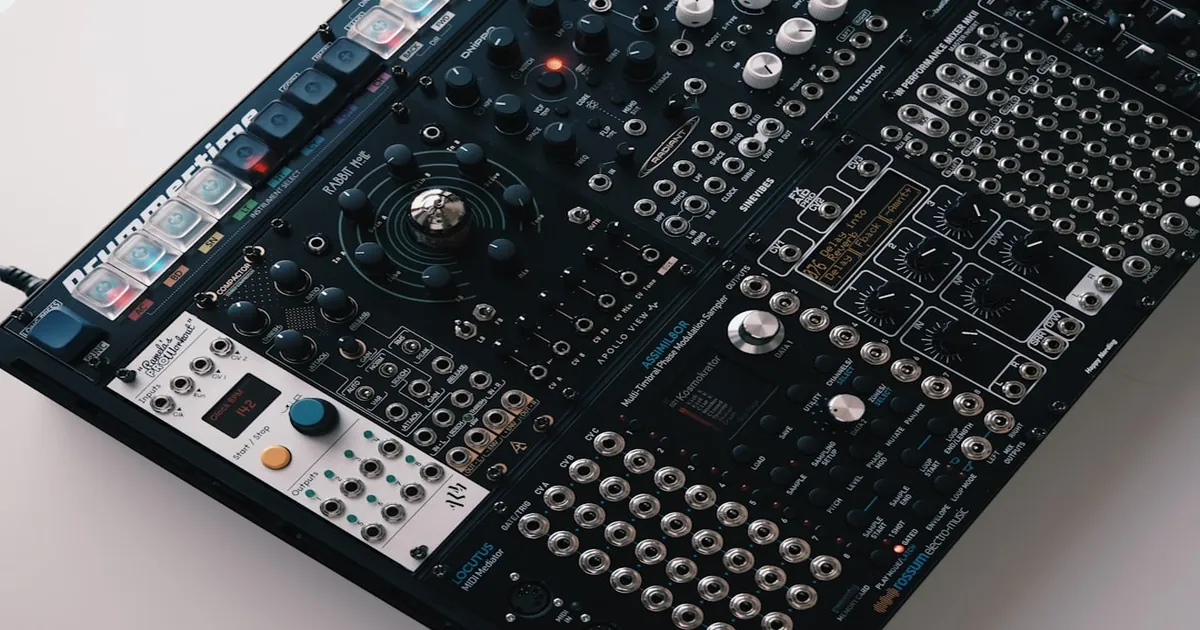
If you've ever wondered why certain synthesizer filters feel more "alive" under modulation — why a Surge XT ladder filter responds differently to a slow cutoff sweep compared to a cheaper emulation — the answer lies in a subtle but fundamental problem in digital filter design that went unsolved for decades.
It's called the unit delay problem, and the fix, Zero-Delay Feedback (ZDF), is one of the more important DSP developments of the last fifteen years.
Analog Filters Don't Wait
In analog circuitry, a feedback loop is exactly that — the output feeds back into the input instantaneously. There is no delay in this process. A transistor ladder filter like the Moog's has four cascaded stages, each an integrator, with a global feedback path wrapping around all of them. The current output feeds back to influence the current input. Simultaneously.
When engineers began modeling these circuits digitally, a problem immediately appeared: you can't compute the output without knowing the input, and you can't know the input without first computing the output. The system is algebraically circular.
The naive solution — used for decades — was to break the loop with a unit delay: put a z⁻¹ in the feedback path, which means "use the output from the previous sample instead of the current one." This makes the equations explicit and easy to solve sequentially. It also introduces a subtle but real error into the filter's topology.
What a Unit Delay Actually Does
Adding a z⁻¹ to the feedback path is not a neutral operation. It moves the poles of the filter, warps the frequency response, and fundamentally changes how the filter behaves under modulation.
Under static conditions — stable cutoff, stable resonance, gentle playing — this warp is often inaudible. The filter still sounds like a filter. But under dynamic conditions, the cracks show:
- Rapid cutoff sweeps: The delayed feedback means the filter lags behind parameter changes in a non-physical way, creating subtle smearing of transients.
- High resonance: The pole-drift becomes significant. The filter's self-oscillation point shifts compared to the analog original.
- Nonlinear saturation: When you drive analog filters into saturation, the nonlinearity interacts with the feedback. A unit-delay model can't handle this correctly — the saturation ends up "outside" the feedback loop instead of embedded within it.
The result isn't catastrophic. It's a softening of the filter's character, a kind of digital smoothing that sounds fine on a pad but wrong on a squelchy acid bass.
Zavalishin's Insight: Solve the Implicit Equation
Vadim Zavalishin, working at Native Instruments, formalized the solution in a document that became essential reading for audio DSP developers: The Art of VA Filter Design. The key insight is to stop trying to avoid the implicit equation and instead solve it directly.
The circular dependency — output depends on input, input depends on output — is what mathematicians call an implicit equation. Rather than breaking the loop with a delay, you solve for the current output algebraically before proceeding to the next sample. This is possible because the equations, while circular, are not infinite. They have a finite, computable solution at each sample.
Zavalishin called this approach Topology-Preserving Transform (TPT), because it preserves the exact feedback topology of the analog circuit. The digital model isn't an approximation of the analog behavior — it is the analog behavior, computed correctly sample-by-sample.
Trapezoidal Integration: The Foundation
ZDF implementations typically use the trapezoidal integration rule rather than the simpler forward Euler method:
y[n] = y[n-1] + (T/2) * (u[n] + u[n-1])This approximates the integral using the average of the current and previous input values. Compare this to forward Euler, which only uses the previous value:
y[n] = y[n-1] + T * u[n-1] // Forward EulerThe trapezoidal rule has two important advantages. First, it's stable across the entire frequency range up to Nyquist — forward Euler becomes unstable at high frequencies. Second, it maps to the bilinear transform, which is the standard method for converting analog filter designs to digital while preserving their frequency-domain behavior.
The trapezoidal integrator, combined with implicit equation solving, gives you a digital filter that tracks its analog counterpart accurately across the full parameter space.
The Moog Ladder: A Case Study
The Moog transistor ladder is the canonical test case for ZDF because it's both iconic and technically demanding. Four cascaded one-pole stages, global negative feedback, inherent saturation from transistor nonlinearities.
A ZDF Moog model sets up the four integrator states as a system of implicit equations and solves them simultaneously at each sample. The feedback term is included in this solve, not delayed until the next sample. For the nonlinear version, this usually involves Newton-Raphson iteration — an iterative solver that converges on the correct output within a few steps.
The difference in behavior is most pronounced when you push the filter hard. A ZDF ladder self-oscillates with the same tonal coherence as the hardware — the self-oscillation frequency is stable and musical. A unit-delay ladder tends to drift or sound slightly "off" under the same conditions.
Urs Heckmann (u-he) has documented this extensively in his filter research. His finding: under "tame" musical conditions the two approaches sound nearly identical. But once you start sweeping aggressively, automating resonance, or driving the filter into saturation, the ZDF version maintains tonal integrity while the unit-delay version begins to break down.
Where This Matters in Practice
Synth filters under modulation: The most common scenario. If you're designing an LFO-modulated filter sweep for a sequence, ZDF tracking means the filter responds to the LFO linearly and proportionally. The cutoff you dial in at the LFO peak is the cutoff you get, not some sample-delayed approximation.
Self-oscillating filters: Filters that self-oscillate can be used as oscillators themselves (think classic acid basslines). A ZDF filter self-oscillates at the precise frequency corresponding to its cutoff setting. Unit-delay filters can exhibit pitch drift under self-oscillation.
Filter distortion: Many VA synthesizers allow driving the filter with hot signals. ZDF models the nonlinear interaction between signal level and filter poles correctly, producing the same odd harmonic distortion pattern as the hardware. This is the "analog warmth" that's difficult to pin down but immediately audible.
Which Plugins Use ZDF
Surge XT (free, open-source): Its ladder, K35, and diode ladder filters are ZDF implementations. The source code is publicly available and a good starting point for studying real-world ZDF implementations.
u-he Synthesizers (Zebra, Hive, Repro): Urs Heckmann has built ZDF into his filter designs across the product line. Repro specifically targets hardware emulation and uses ZDF as central to its accuracy.
Bitwig Studio's built-in filters: The LD (Ladder) filter and several Grid filters use implicit modeling approaches for their nonlinear options.
The performance cost of ZDF — mainly the iterative solving — is modest on modern CPUs. A Newton-Raphson solve for a four-pole ladder typically converges in two to three iterations, adding only a few multiply-accumulate operations per sample compared to a simple unit-delay model.
If You're Building Filters
If you're working in JUCE or any C++ audio framework and want to implement a resonant filter that responds well to modulation, the practical starting points are:
- Read Zavalishin's The Art of VA Filter Design — it's freely available as a PDF and walks through the mathematics in full.
- Study the Surge XT source code — the filter implementations are clean and well-commented.
- For a one-pole lowpass, the ZDF version is actually simpler to implement than you'd expect. The implicit equation for a single pole has an exact closed-form solution.
The unit delay is a known approximation error that was accepted for years because it was computationally convenient. ZDF removed that constraint. The filters in your synth can now behave the way the engineers who designed the originals intended — continuous, topologically correct, and honest about where the poles actually are.
That's why some filter emulations feel alive, and others don't quite get there.